

Workout Plan for Beginners
Starting a fitness routine can feel overwhelming without a clear structure.
Most beginners ask:
- Where should I start?
- How often should I exercise?
- Do I need equipment?
- Should I do cardio or strength training first?
- How long should each workout last?
The answer is simple.
A successful workout plan for beginners focuses on:
- consistency
- movement quality
- gradual progression
- recovery balance
This guide provides a complete 4-week plan designed for home or gym training.
The CDC physical activity guidelines for adults recommend consistent weekly activity to improve strength, endurance, and metabolic health:
Table of Contents
Why Beginners Need a Structured Workout Plan
Random workouts often lead to slow progress and early dropout.
A structured routine helps:
- improve movement coordination
- activate major muscle groups
- increase metabolic efficiency
- prevent injury risk
- build long-term exercise habits
Consistency matters more than intensity during the first month.
What Happens During Your First Month of Exercise
Beginners experience rapid adaptation because the nervous system improves movement efficiency before muscle size increases.
Common early improvements include:
- better posture
- increased stamina
- reduced fatigue
- improved sleep quality
- stronger joint stability
- improved circulation
These changes usually appear within 2–4 weeks.
Beginner Fitness Goals for the First 4 Weeks
Focus on building a foundation rather than chasing rapid transformation.
| Goal | Expected Result |
| Learn correct exercise form | Reduced injury risk |
| Improve movement confidence | Faster long-term progress |
| Increase daily activity level | Better metabolism |
| Build routine consistency | Sustainable fitness habit |
| Strengthen joints and muscles | Safer progression later |
Who This Workout Plan Is Designed For
This plan works well for:
- first-time exercisers
- people restarting fitness after a break
- remote workers
- busy professionals
- students
- parents managing limited time
It requires no advanced equipment.
Who Should Modify This Plan First
Consult a healthcare professional before starting if you have:
- chronic joint pain
- recent surgery
- cardiovascular conditions
- uncontrolled hypertension
- persistent back pain
Safety always comes first.
4-Week Beginner Workout Plan Overview
Each week introduces a small progression step.
| Week | Focus |
| Week 1 | Learn movement patterns |
| Week 2 | Increase repetitions |
| Week 3 | Improve endurance |
| Week 4 | Increase intensity |
Gradual progress improves results safely.
Weekly Workout Schedule for Beginners
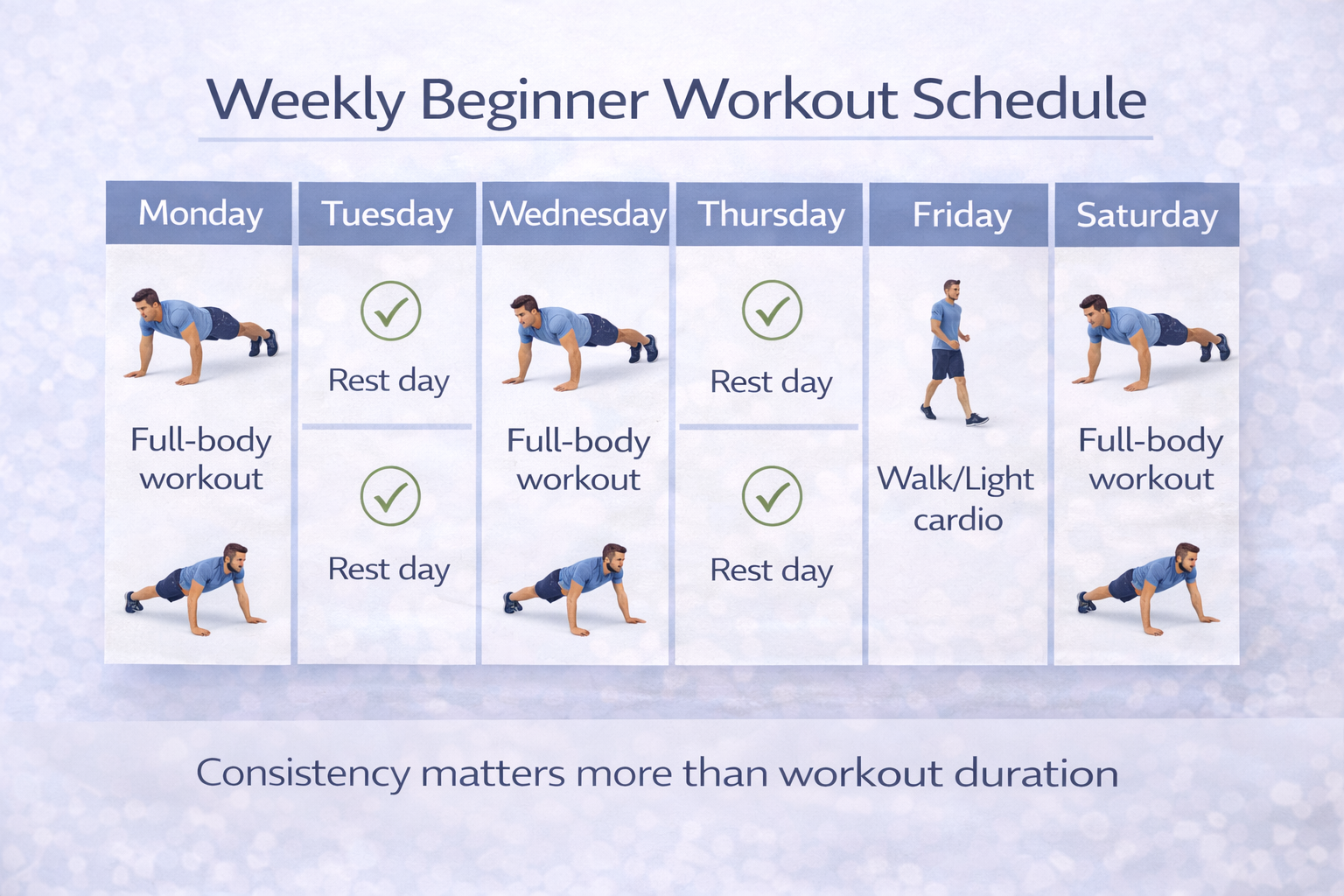
Follow this weekly structure.
| Day | Activity |
| Monday | Full-body strength |
| Tuesday | Light cardio + mobility |
| Wednesday | Rest or walking |
| Thursday | Strength training |
| Friday | Core + cardio |
| Saturday | Light activity |
| Sunday | Recovery |
This schedule balances effort and recovery.
Week 1 Beginner Workout Plan
Goal: Learn movement patterns
Exercises:
- chair squats
- wall pushups
- standing knee lifts
- glute bridges
- arm circles
Routine:
- 2 sets per exercise
- 10 repetitions per set
- rest 45–60 seconds between sets
Workout duration: 15 minutes
Focus on correct form rather than speed.
Week 2 Beginner Workout Plan
Goal: Increase repetition tolerance
Exercises:
- bodyweight squats
- incline pushups
- forward lunges
- bird dogs
- plank hold (20 seconds)
Routine:
- 2–3 sets per exercise
- controlled movement tempo
Workout duration: 18 minutes
Strength begins improving noticeably during this phase.
Week 3 Beginner Workout Plan
Goal: Improve endurance and stability
Exercises:
- squats
- pushups
- reverse lunges
- glute bridges
- plank (30 seconds)
Routine:
- 3 sets per exercise
- 45 seconds rest between sets
Workout duration: 20 minutes
Confidence increases significantly during this week.
Week 4 Beginner Workout Plan
Goal: Introduce light intensity progression
Exercises:
- squats
- pushups
- step-back lunges
- mountain climbers
- plank (40 seconds)
Routine:
- circuit format
- 3 rounds total
- 60 seconds rest between rounds
Workout duration: 22 minutes
Endurance improves rapidly at this stage.
Best Exercises for Beginners
These movements activate multiple muscle groups efficiently.
| Exercise | Benefit |
| Squats | Leg strength and metabolism |
| Pushups | Upper-body strength |
| Lunges | Balance and coordination |
| Planks | Core stability |
| Glute bridges | Lower-back support |
| Bird dogs | Posture improvement |
Repeat weekly for best results.
Beginner Home Workout Plan (No Equipment Required)
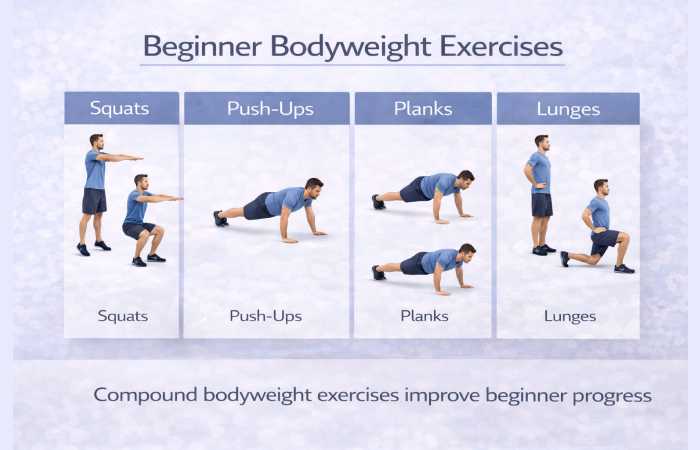
Routine structure:
- squats
- pushups
- lunges
- plank
- jumping jacks
Perform:
- 3 rounds
- 10 repetitions per exercise
- 45 seconds rest between exercises
Total workout time: 15–20 minutes
Beginner Gym Workout Plan Option
If gym access is available, start with machines.
Suggested routine:
- leg press
- chest press
- lat pulldown
- seated row
- treadmill walking
Perform:
- 2 sets per exercise
- light to moderate resistance
Machines improve movement safety for beginners.
Beginner Cardio Plan
Cardio improves endurance and supports fat metabolism.
Recommended beginner cardio options:
- brisk walking
- stationary cycling
- stair climbing
- low-impact jogging
Start with:
10 minutes daily
Increase gradually each week.
Why Strength Training Helps Beginners Lose Fat Faster
Strength training increases lean muscle mass.
More muscle increases resting metabolism.
Benefits include:
- improved calorie burn
- better insulin sensitivity
- stronger posture
- improved daily energy
Strength training should always remain part of a beginner routine.
Harvard Health explains beginner resistance training improves metabolism and insulin sensitivity.
Ideal Workout Duration for Beginners
Recommended session length:
15–25 minutes per workout
Longer sessions are unnecessary during early adaptation stages.
Short workouts improve adherence and consistency.
Morning Workout Routine for Beginners
Simple structure:
- jumping jacks
- bodyweight squats
- pushups
- plank hold
Total time: 10 minutes
Morning workouts improve:
- alertness
- metabolic activity
- consistency habits
Evening Workout Routine for Beginners
Suggested routine:
- lunges
- glute bridges
- plank hold
- stretching exercises
Evening workouts support recovery and relaxation.
Beginner Core Workout Routine
Core training improves posture and stability.
Exercises:
- plank hold
- bird dog
- dead bug
- side plank
Perform:
2 rounds total
Many beginners notice reduced back discomfort within weeks.
Beginner Workout Plan for Weight Loss
Use this sequence:
- strength training
- core activation
- cardio finishing
This structure increases calorie burn efficiency.
Beginner Low-Impact Workout Option
Ideal for apartment living or joint sensitivity.
Exercises:
- chair squats
- incline pushups
- step-back lunges
- plank hold
Low-impact routines remain highly effective.
Nutrition Guidelines for Beginners
Support workouts with simple nutrition habits:
Eat:
- protein daily
- fruits and vegetables
- whole grains
- healthy fats
Examples:
- eggs
- yogurt
- lentils
- nuts
- bananas
Nutrition improves recovery speed.
Recovery Strategy for Beginners
Recovery includes:
- 7–8 hours of sleep
- hydration
- stretching
- walking
If Recovery improves performance consistency.
Expected Results Timeline
Typical beginner progress pattern:
Week 1:
movement becomes easier
Week 2:
stamina improves
Week 3:
strength increases
Week 4:
Visible muscle tone improvements begin
Consistency determines outcomes.
Common Beginner Workout Mistakes
Avoid:
- training too hard initially
- skipping recovery days
- changing routines too frequently
- ignoring hydration
- copying advanced athlete routines
Progress gradually.
Motivation Strategy for the First 30 Days
Build consistency through:
- tracking workouts
- scheduling sessions
- measuring repetitions
- monitoring sleep quality
Small wins create long-term success.
Progress Tracking Method for Beginners
Track weekly:
- repetitions completed
- workout duration
- step count
- energy levels
- sleep quality
Tracking improves motivation.
Beginner Stretching Routine
Include after workouts:
- hamstring stretch
- quadriceps stretch
- shoulder mobility rotation
- neck relaxation stretch
Stretching improves flexibility and reduces stiffness.
Signs Your Workout Plan Is Working
Indicators include:
- better posture
- improved stamina
- stronger sleep quality
- reduced joint stiffness
- increased confidence during exercise
These changes appear within weeks.
When to Increase Workout Intensity
Increase difficulty when:
- Exercises feel easy
- Recovery improves quickly
- Stamina increases consistently
Add:
- repetitions
- additional rounds
- shorter rest periods
Progress gradually.
Lifestyle Habits That Improve Results Faster
Combine workouts with:
- hydration
- balanced meals
- sunlight exposure
- regular sleep timing
Lifestyle habits multiply fitness progress.
Beginner Walking Plan (Optional Support Routine)
Walking improves:
- cardiovascular health
- metabolism
- recovery
Daily step target:
6,000–8,000 steps
Walking accelerates early progress.
Common Beginner Mindset Mistake
Many beginners expect immediate transformation.
Real improvement happens in stages:
movement quality
strength adaptation
body composition change
Trust the process.
Who This Article Is For
Best suited for:
- beginners starting fitness
- busy professionals
- students
- remote workers
- people restarting exercise routines
Who This Article Is Not For
Not intended for:
- advanced athletes
- competitive training programs
- bodybuilding preparation routines
FAQs
How many days per week should beginners exercise?
3–5 days weekly is ideal.
Should beginners start with cardio or strength training?
Strength training first produces better long-term results.
How long should beginner workouts last?
15–25 minutes per session.
Can beginners exercise at home?
Yes. Bodyweight routines are effective.
When should beginners increase intensity?
After approximately 3–4 weeks.
Conclusion
Starting a structured workout plan for beginners creates a strong foundation for long-term fitness success. By focusing on full-body movements, gradual progression, balanced recovery, and consistent scheduling, beginners can improve strength, posture, endurance, and energy levels within the first month. The most important step is consistency. A simple daily routine performed regularly produces better results than complex programs performed occasionally.